Krishna Pearls | Buying Guide | 12 min read
Quick Answer
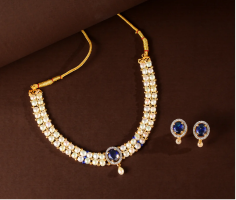
Hyderabad is called the City of Pearls because it has been India's pearl processing and trading capital since the Qutb Shahi and Nizam eras — the pearls are imported raw from Japan, China, Australia and the South Seas, then drilled, bleached, graded and strung by Hyderabadi craftsmen. The traditional pearl market runs along Pathragatti near Charminar, with modern showrooms in, Jubilee Hills and Kokapet, Kondapur, A genuine Hyderabad pearl set (necklace plus earrings) typically starts around ₹5,000 for freshwater pearls and rises past ₹1,50,000 for certified South Sea and Japanese Akoya pieces. Always buy against a certificate of authenticity and a written buy-back policy.
Why Hyderabad is called the City of Pearls
Hyderabad has no coastline and no oyster beds. It became the pearl capital of India for a very different reason: skill.
When the Qutb Shahi rulers and later the Nizams built their court in the Deccan, pearls arrived as tribute and trade goods from the Persian Gulf — the famous Basra pearls — and from Ceylon. Somebody had to sort them, drill them, bleach them and string them into the extravagant pieces the court demanded. Families of craftsmen settled around Charminar to do exactly that, and stayed. Four centuries later, their descendants still do it.
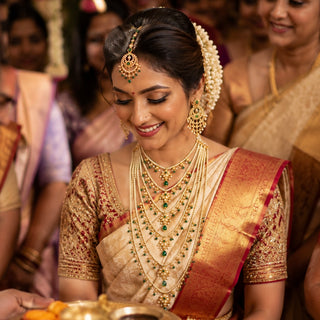
The Nizams' collection remains the reference point for what Hyderabadi pearl work looks like at its peak: the seven-string satlada, the ropes of graduated pearls, the chandanhaar and rani haar forms that are still the basis of bridal design in the city today.
What this means for a buyer: "Hyderabad pearls" is not a species of pearl. It is a standard of processing — hand-drilling, hand-knotting, careful lustre matching and grading. When you buy from Hyderabad, you are buying craftsmanship applied to imported raw pearls, not a locally farmed gem.
Where Hyderabad's pearls actually come from
Being clear about sourcing is the fastest way to tell an honest jeweller from a careless one. Today the raw material reaches Hyderabad from four main origins:
-
Freshwater pearls (China): the volume market. Wide range of shapes and colours, very affordable, ideal for everyday wear and layered designs.

-
Akoya pearls (Japan): small, near-perfectly round, famously mirror-bright. The classic single-line necklace pearl.

-
South Sea pearls (Australia, Indonesia, Philippines): large — often 10mm to 16mm — in white, silver and rich golden tones. The premium end.

-
Tahitian pearls (French Polynesia): naturally dark, in peacock, grey and aubergine shades.

Basra pearls — natural, undrilled by machine, sourced from the Gulf before the fisheries collapsed — are now essentially antique. Anything sold as a new Basra pearl deserves hard questions and a laboratory report.
The pearl market in Hyderabad, area by area
Shoppers usually mean one of two very different things by "the pearl market in Hyderabad".
Pathragatti and Charminar — the historic trade quarter
The stretch of Pathragatti running from Charminar is where the trade has lived since the beginning, alongside Laad Bazaar's bangle shops. It is dense, loud, and full of everything from ₹200 souvenir strings to serious South Sea strands. The quality range is enormous, and so is the difference between shops. Go here for atmosphere and for the established houses that have been on this road for decades — not for a blind bargain hunt.
Near Charminar, Kondapur, — the showroom belt
Air-conditioned, certified, fixed-price. This is where most Hyderabadis actually buy a wedding set, because you get grading documentation, hallmarked gold on the mounts, exchange terms in writing and staff who will let you compare twenty necklaces without pressure.
Jubilee Hills, Banjara Hills and Kokapet — the newer retail hubs
Designer-led collections, contemporary settings, and the pieces most likely to suit office wear and cocktail dressing rather than a full bridal look.
Practical tip: whichever area you choose, ask three questions before you look at a single price tag — where the pearl is from, whether it is cultured or imitation, and whether the shop provides a written certificate. A shop that answers all three without hesitating is worth your time.
Types of Hyderabad pearl jewellery worth knowing
The vocabulary matters when you are describing what you want:
-
Satlada: the seven-string necklace, the most Hyderabadi form there is. Formal, heavy, bridal.
-
Chandanhaar: multiple strands linked by decorative spacers, falling in tiers.
-
Rani haar: the long queen's necklace, usually worn with a shorter choker.
-
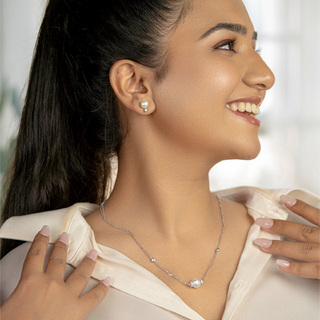
Single-line necklace: one strand of graduated or uniform pearls. The piece that works with a saree and with a shirt.
-
Chokers and collars: shorter, closer to the throat, increasingly popular for receptions.
-
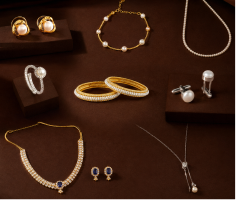
Jhumkas and studs: pearls set into gold bells or drops — the easiest entry point into pearl jewellery.
-
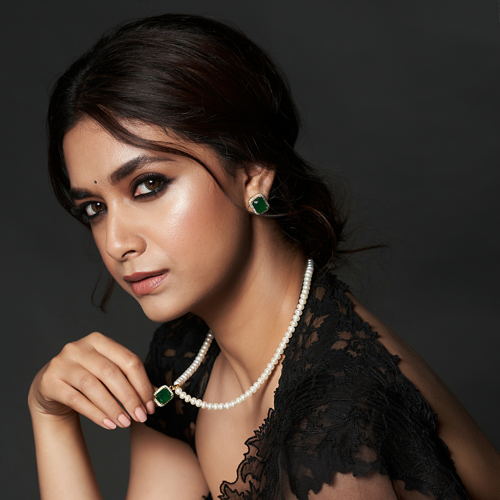
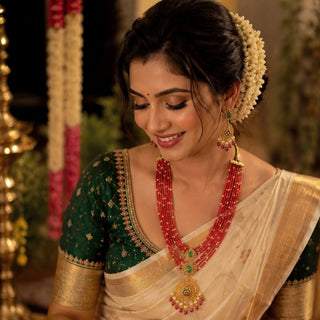
Pearl and polki or pearl and emerald combinations: the Deccan signature, and still the most requested bridal style in the city.
Choosing a Hyderabad pearl set: what actually decides quality
Five factors move the price of a pearl set far more than the design does.
-
Lustre. Hold the pearl under a light. You should see a sharp reflection, not a soft glow. Dull lustre means thin nacre, and thin nacre wears through.
-
Surface. Minor markings are natural. Pits, cracks and visible drill chipping are not acceptable at any price point.
-
Shape. Perfectly round costs the most. Oval, drop, button and baroque shapes cost less and often look more interesting in modern settings.
-
Size. Priced non-linearly — a 10mm pearl costs far more than twice a 5mm pearl of the same grade.
-
Matching. In a strand, the consistency of colour, size and lustre across every pearl is a large part of what you are paying for. This is where Hyderabadi stringing skill shows.
Hyderabad pearl set price guide
Indicative ranges for a matched set — necklace plus earrings — bought from an established showroom:
| Pearl type |
Typical set range |
Best for |
| Freshwater, single line |
₹5,000 – ₹25,000 |
Daily wear, gifting, first purchase |
| Freshwater, multi-strand / chandanhaar |
₹25,000 – ₹80,000 |
Festive and family functions |
| Japanese Akoya |
₹40,000 – ₹2,00,000 |
Formal classic necklaces, heirloom gifting |
| South Sea (white or golden) |
₹1,50,000 upward |
Statement and investment pieces |
| Bridal satlada / pearl-polki sets |
₹1,00,000 upward |
Wedding trousseau |
| Pearl studs and jhumkas |
₹2,000 – ₹35,000 |
Everyday, office, gifting |
These are indicative only. Final pricing depends on pearl grade, strand length, the gold rate on the day and the weight of gold in the mounts. Ask for the pearl value and the gold value to be shown separately on the estimate — a good jeweller will do it without being asked twice.
How to tell a real pearl from an imitation
Six checks you can do standing at the counter:
-
The tooth test. Rub the pearl lightly against the edge of a tooth. Real nacre feels faintly gritty; glass and plastic feel glassy-smooth.
-
Temperature. A real pearl feels cool for a moment before it warms to your skin. Plastic is at room temperature immediately.
-
The drill hole. Look at it closely. A cultured pearl shows a clean, sharp edge and often a fine line where nacre meets the bead nucleus. Imitations show flaking or paint pooling.
-
Weight. Real pearls have noticeable heft for their size. Plastic imitations feel weightless.
-
Imperfection. Every pearl in a real strand is slightly individual. Flawless uniformity across every single pearl is a warning sign, not a virtue.
-
Certification. The only conclusive test. Ask for a laboratory report identifying the pearl as natural or cultured, plus BIS hallmarking on the gold components.
Caring for pearl jewellery in Hyderabad's climate
Nacre is organic and porous, which makes it more delicate than any gemstone you own. The rules are simple:
- Last on, first off. Perfume, hairspray, deodorant and cosmetics all attack nacre — put pearls on after you are ready, take them off before you undress.
- Wipe each pearl with a soft, slightly damp cloth after wearing, and let them dry fully before storing.
- Store in a soft cloth pouch, never loose in a box with harder jewellery that will scratch them.
- Never use ultrasonic cleaners, steam, bleach or ammonia-based cleaners.
- Restring frequently worn strands every one to two years. Silk stretches, and a snapped strand on a wedding day is entirely preventable.
- Pearls do best when worn. Skin oils help maintain their lustre; a decade locked in a safe does not.
Buying pearls at Krishna Pearls, Jubilee Hills, Hyderabad
Krishna Pearls Jubilee Hills is part of the Krishna Jewellers Pearls & Gems group, which began at Pathragatti near Charminar in 1983 and now runs seven showrooms across Hyderabad. That means both ends of the city's pearl trade under one name — the old-quarter sourcing relationships and the modern showroom experience with certification, hallmarking and written policies.
What that looks like in practice:
- Pearls sourced directly from Japanese, Chinese, Australian and South Sea suppliers, then graded and strung in Hyderabad.
- Certificate of authenticity with every pearl purchase and BIS hallmarking on gold mounts.
- Bridal consultations that match the set to the outfit, the neckline and the rest of the trousseau.
- Live video shopping and worldwide shipping for NRI customers who cannot visit in person.
- Transparent exchange and buy-back terms, issued in writing at the time of purchase.
Browse the pearl necklace collection, the pearl sets or pearl earrings online, or find your nearest showroom in Hyderabad.
Frequently asked questions
Why is Hyderabad called the City of Pearls?
Because it has been India's centre for pearl processing and trading since the Qutb Shahi and Nizam periods. Pearls arrived as trade and tribute, and generations of craftsmen around Charminar specialised in drilling, bleaching, grading and stringing them. The title describes the craft and the trade, not local pearl farming.
Are pearls actually found in Hyderabad?
No. Hyderabad is landlocked and has no oyster beds. Raw pearls are imported — freshwater pearls from China, Akoya pearls from Japan, South Sea pearls from Australia, Indonesia and the Philippines — and are then processed and finished in Hyderabad.
Where is the best pearl market in Hyderabad?
Pathragatti near Charminar is the historic pearl market and still the densest concentration of pearl shops in the city. For certified pieces with hallmarked gold and written exchange policies, most buyers prefer established showrooms in Basheerbagh, Somajiguda, Jubilee Hills or Kukatpally.
How much does a pearl set cost in Hyderabad?
A freshwater pearl set typically starts around ₹5,000 and runs to about ₹25,000. Japanese Akoya sets generally range from ₹40,000 to ₹2,00,000, and South Sea sets begin around ₹1,50,000. Price depends on lustre, size, shape, matching and the weight of gold in the mounts.
How can I tell if a Hyderabad pearl is real?
Rub it gently against a tooth — real nacre feels slightly gritty. Check that it feels cool and has weight, inspect the drill hole for clean edges, and look for the small natural variations that appear in any genuine strand. For certainty, insist on a laboratory certificate identifying the pearl as natural or cultured.
Which pearls are best for a bride?
Traditional Hyderabadi bridal sets use a satlada, chandanhaar or rani haar, often combining pearls with polki or emeralds. Larger South Sea or well-matched Akoya pearls carry best under heavy bridal outfits, while freshwater multi-strand designs give the same visual weight at a lower cost.
Can I buy Hyderabad pearl jewellery online or from abroad?
Yes. Krishna Pearls ships worldwide and offers live video consultations, so NRI customers can see pieces on camera, ask for close-ups of lustre and drill holes, and complete the purchase remotely with the same certification issued in store.
See the pearls before you decide
Book a live video call with our pearl specialists, or visit any of our seven Hyderabad showrooms. We will walk you through grading, matching and pricing with no obligation to buy.
Chat on WhatsApp Find a showroom




 Festive Giftbox
₹ 1,300
Festive Giftbox
₹ 1,300